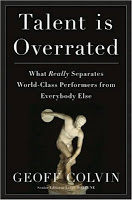
 Talent is Overrated: What Really Separates World-Class Performers from Everybody Else
By Geogg Colvin
Geoff Colvin is a Senior Editor and columnist for Fortune Magazine. In print and on television and radio, he reports about personal and business successes and the reasons for those results. In this book, Colvin examines whether success is determined by nature or nurture.
Colvin draws on scientific studies and supporting anecdotes to explain that the common belief that a person is born with superior talent in a certain field is a myth. The author states that the belief in that myth is an impediment to an individual’s potential achievements. Using examples such as Tiger Woods and Mozart, Colvin examines the processes that helped these achievers exceed the accomplishments of others in the same fields.
Old joke: Q. “How do you get to Carnegie Hall?”
A “Practice, practice, practice.”
Colvin agrees that practice is the way to become a superstar. But not mindless, automatic repetition of previous practices. To become the very best, you must engage in deliberate and thoughtful practice designed to be physically and/or mentally demanding and increasingly challenging. Those striving to be the very best must be prepared to practice thoughtfully, always reaching a little further to get closer to the desired goal.
Essential to this process is a discerning teacher, whether a parent or an outsider. In the cases of Amadeus Mozart and Tiger Woods, that teacher was a demanding father. Leoplod Mozart and Earl Woods started tutoring their sons at age three. Those extra early years of education and immersion in their skill sets gave them a head start over the talents and training of others starting at a later age.
This book is targeted to a business audience. But, if your charge is a child prodigy, you can provide a nurturing environment. You want to do your best to prevent a precocious child from becoming a Michael Jackson-like-immature-adult/child.
This book is subtitled “What Really Separates World-Class Performers from Everybody Else.” For nannies, au pairs, parents, and all child caregivers, that should mean recurring and self-critical self-appraisal of your actions and the consequent reactions of the children.

 bethebestnanny.com
Thanks for posting an intelligent book that most nannies would never ever think of reading. I think it's time for your subscribers to focus on some of these other books not just Tasha Blains' book. I think the topic of nature and nurture is interesting and can be useful!! I will pick it up and give it a read!